
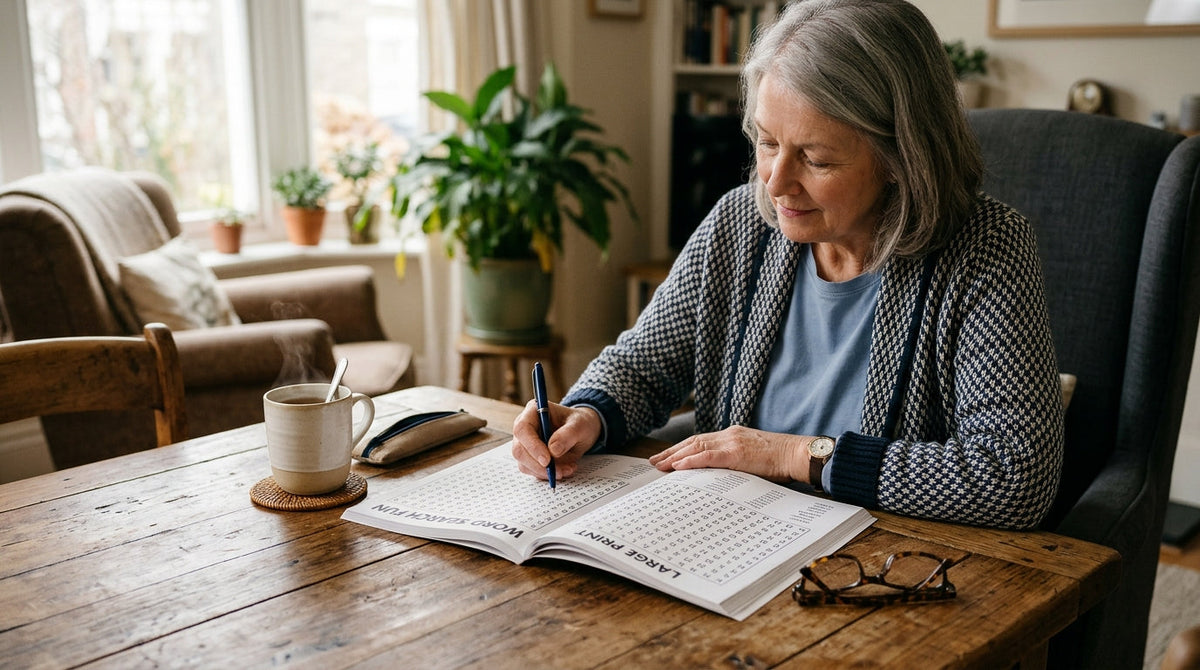
Large print on a puzzle book cover sounds like a simple promise — bigger letters. But the difference between standard and large print changes more than the font size. It changes how you interact with the grid, how long you can work comfortably, and who can use the book at all.
The size difference
Standard word search grids are typically set in 9 to 11 point type. Large print pushes that to 16 or 18 points — roughly double. The letters themselves take up more space on the page, which means either the grid shrinks to fewer rows and columns, or the page size grows. Most large print puzzle books keep a standard page size and reduce the grid, giving each puzzle fewer words but more visual breathing room.
What it solves
Small type in a dense grid creates two problems at once. First, the letters crowd together, making it harder to follow a word across a row or down a diagonal without losing your place. Second, the physical act of reading tiny characters for an extended period causes eye strain. Large print solves both. The spacing between letters opens up, and each character is legible without effort. A puzzle that took concentration just to read now takes concentration only to solve.
Who benefits
The obvious answer is people with low vision — age-related or otherwise. But large print also helps anyone working in imperfect conditions. Reading in dim light, solving puzzles without glasses, or working at arm's length on a plane all become easier with larger type. Children learning to recognize letters benefit from the clarity. So do people recovering from eye surgery or managing headaches. Large print is not a niche feature; it is a design decision that makes the puzzle accessible to more people in more situations.
The tradeoff
Larger letters mean fewer of them per page. A large print puzzle book typically offers grids with 12 to 15 words rather than 20 to 30. For solvers who want a long, dense challenge, that can feel thin. The solution is not to avoid large print but to buy books designed around it — books where the themes, vocabulary, and difficulty are calibrated for the grid size rather than squeezed into a format that does not fit.
Explore our large print word search collections at Puzzle Books Co.